
Boca Iglesia: A Threshold of Faith, Memory, and Origin in Isla Mujeres
El Cronista y La Peregrina
What is the most historically significant cultural site of Isla Mujeres? It’s not what you think. Not Punta Sur, not the visible ruins, not the places that appear on maps or itineraries. It is Boca Iglesia — Isla Mujeres’ best kept secret, and in my opinion, one of the most important historical sites in all of Mexico.
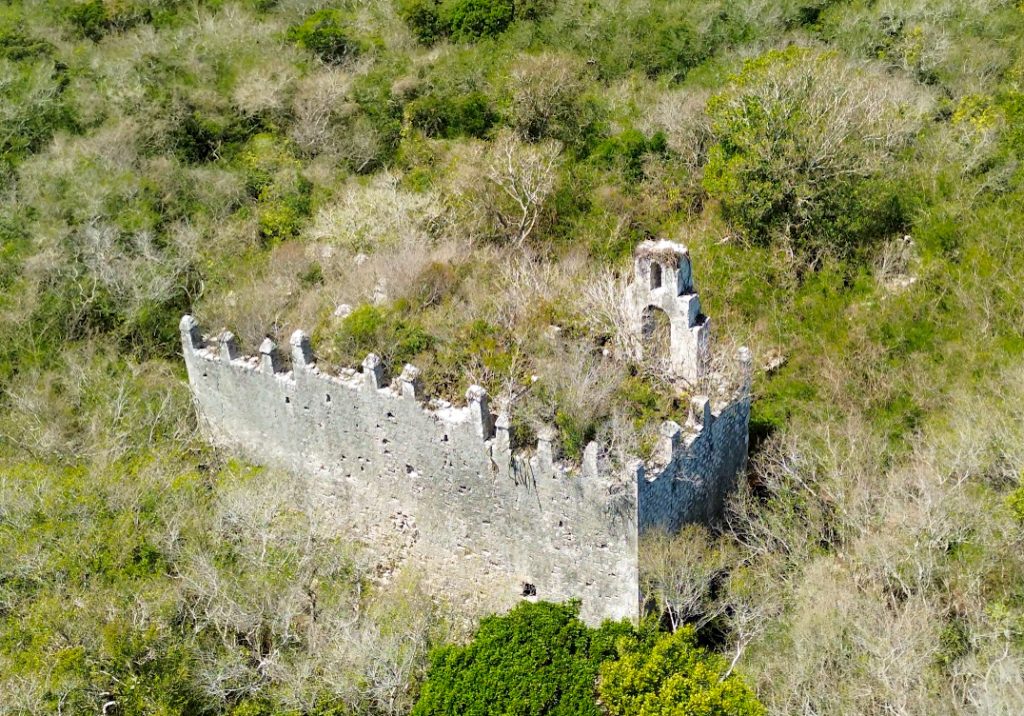
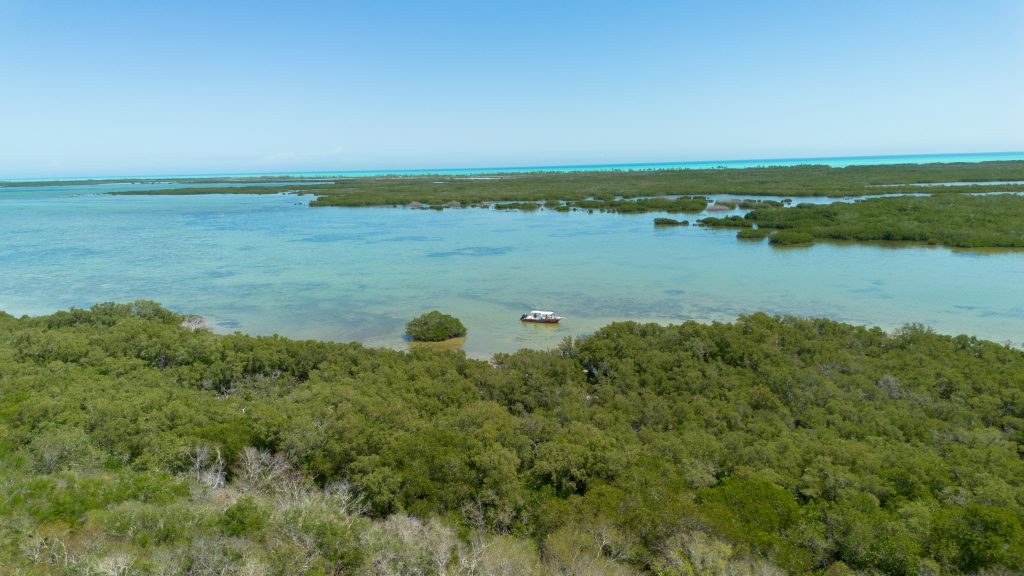
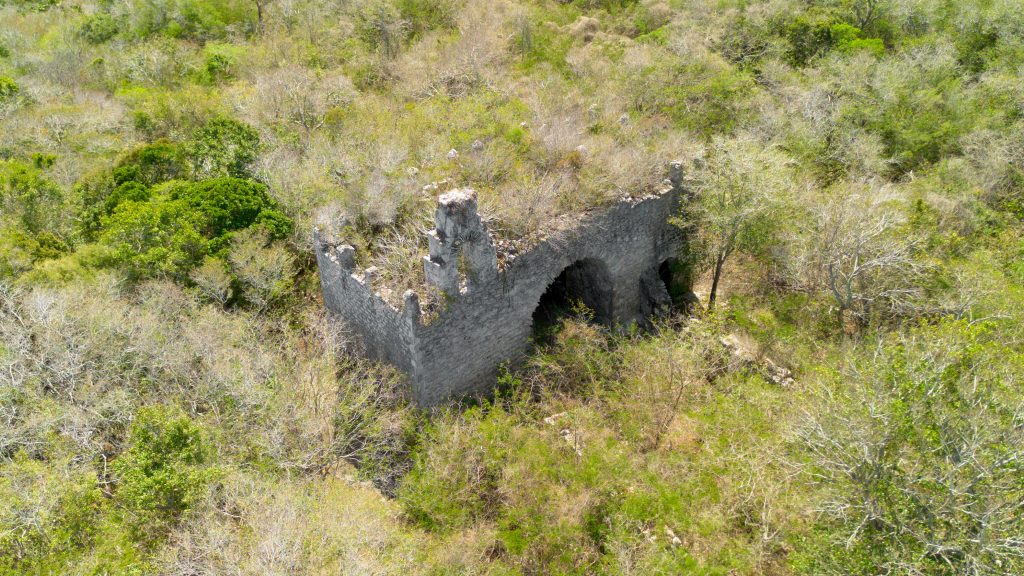
Boca Iglesia is not on the island itself, but within the continental zone of the municipality — a reminder that Isla Mujeres is not only the island, but a much larger geography that extends across water, mangrove, and mainland. It exists beyond the routes most people take, held quietly between lagoon and sea, connected but not exposed. Even in geography, it resists being easily placed.
To understand Boca Iglesia, you have to begin before it was ever called that. Before the Church, before the Virgin, before the Spanish arrival in 1517. This entire region once formed part of Ekab — a coastal world of Mayan navigators and traders who moved by canoe along what is now known as the Costa Oriental. This was not an isolated edge, but a corridor where movement, exchange, and belief flowed continuously. This was a world shaped by the sea, where navigation, trade, and spirituality were deeply intertwined, and where the presence of Ixchel lived within the rhythm of the coast.
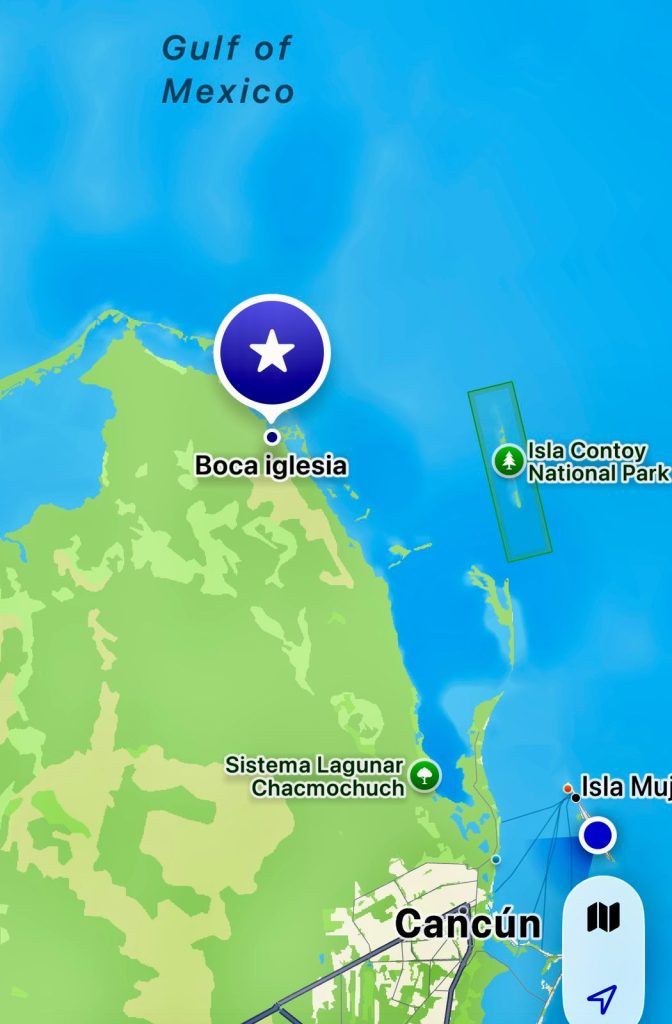
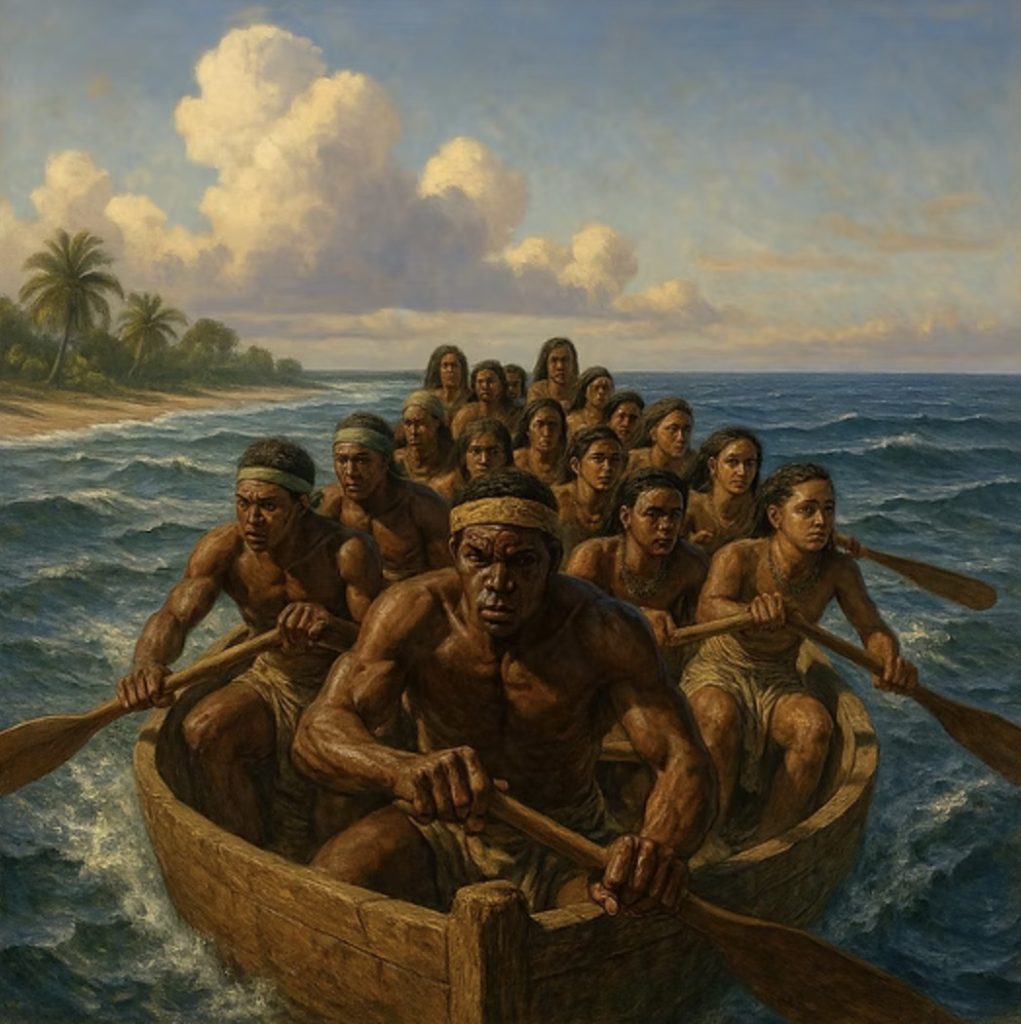
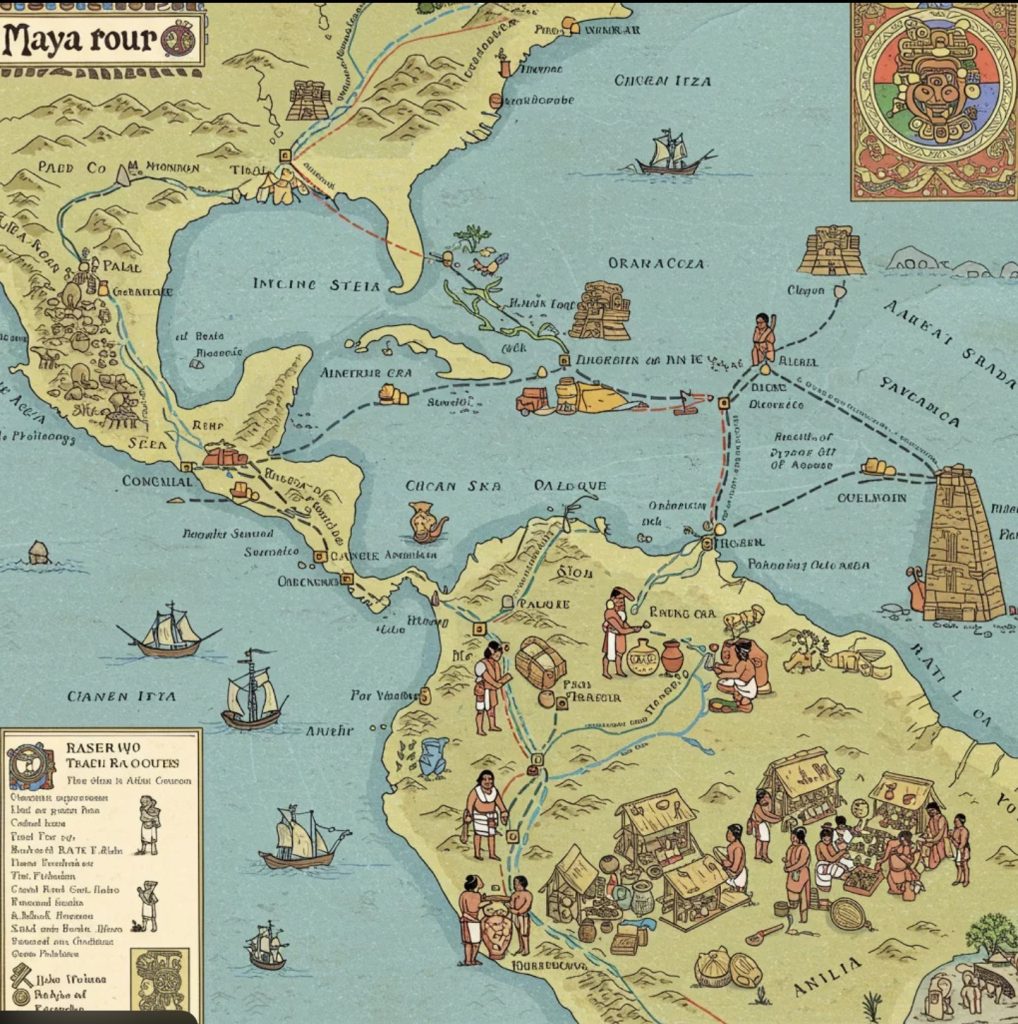
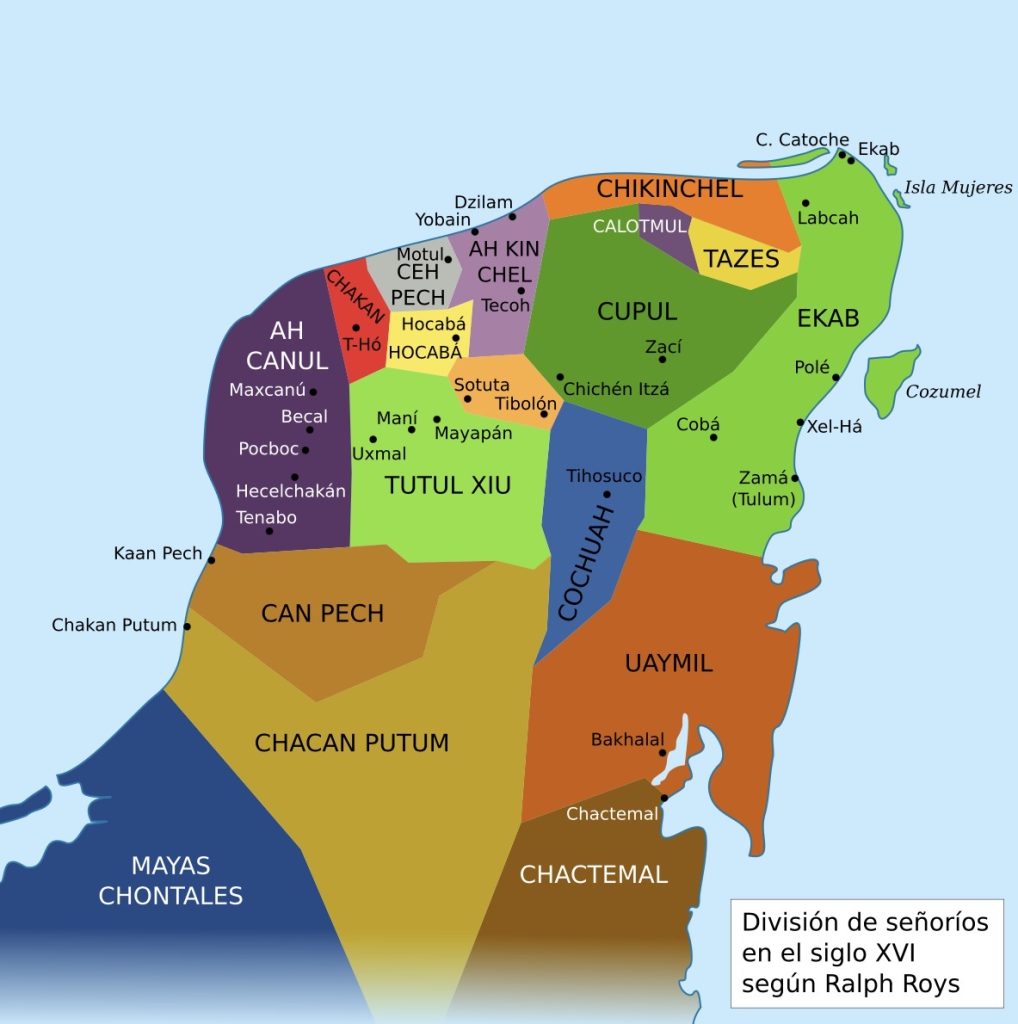
In 1517, Spanish explorers arrived along this same coastline, marking one of the earliest points of contact between Europe and what would later become Mexico. Expeditions in 1518 and 1519 followed these same maritime routes. Within this moment, Boca Iglesia begins to take shape — not as a center, but as a threshold, one of the earliest attempts to establish a Catholic presence along this coast.
What followed was not permanence, but intention. The Crown ordered the creation of what Fidel Villanueva Madrid refers to as the first Obispado Carolino in all of Mexico— an effort to anchor the Church at the very place where the Spanish first disembarked. At that time, the earliest Catholic images assigned to the Indigenous parish of Ekab were those of San Clemente and Santa María de los Remedios. But the project was short-lived. With no gold to sustain colonial interest, attention shifted inland, where wealth and resources were more immediate. By the mid-17th century, the coastal mission was abandoned, leaving behind fragments — structures, memory, and intention. And yet, even in its failure, it remains one of the earliest recorded attempts to establish Catholicism in what would become New Spain, later Mexico — a quiet but deeply significant chapter in the historical legacy of Isla Mujeres.
The story that followed is not linear.
In May of 1911, nearly 250 years later, fishermen from Isla Mujeres arrived at Boca Iglesia and encountered a figure of the Virgin Mary within the ruins. These fishermen were Spanish and mestizo descendants who had fled the violence of the Caste War of Yucatán, later settling on the island and already carrying with them a deeply rooted Catholic faith shaped through colonization and conversion in the Yucatán.
They did not arrive with much. And in that context, the discovery of the image would not have been ordinary, but profoundly meaningful — something to be received, protected, and understood as a gift from God.
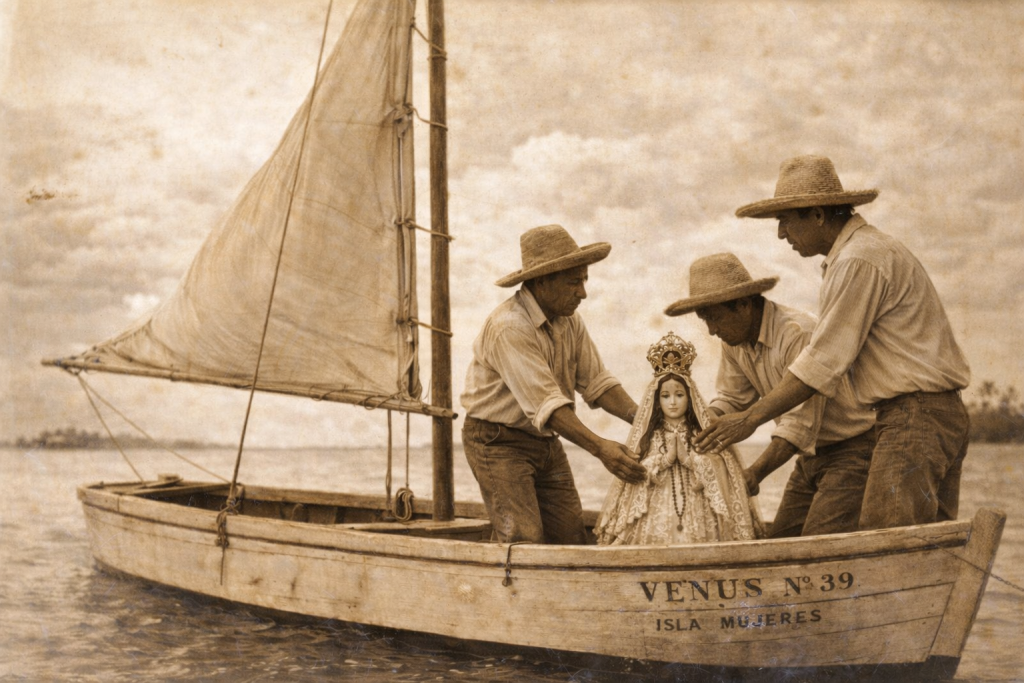
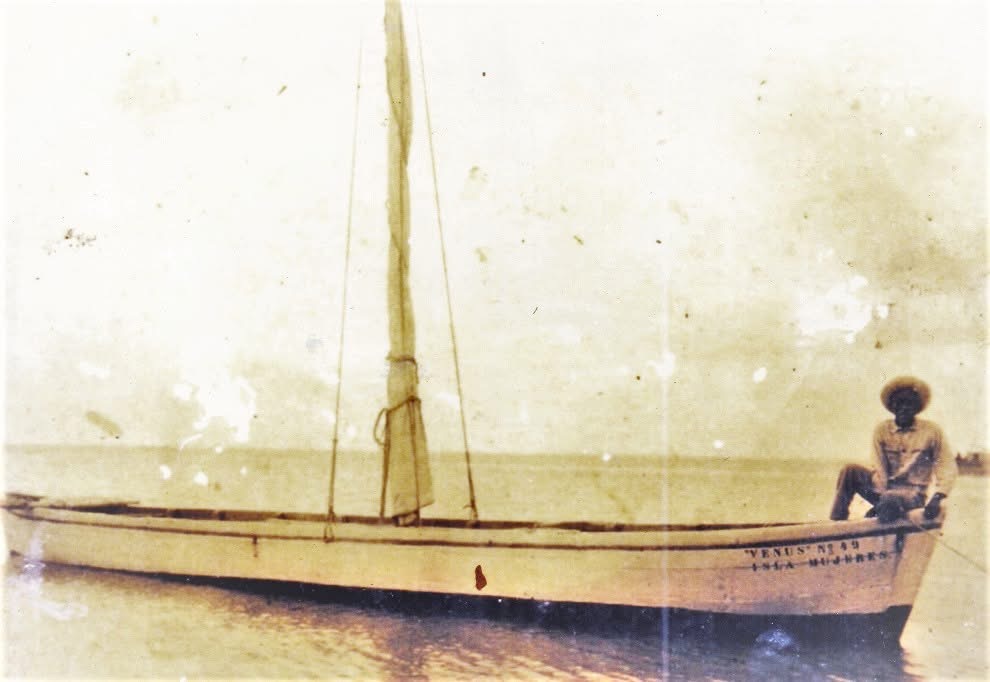
AI generated image of what it may have looked like when the fishermen arrived to Isla Mujeres with the Virgin and Venus, the actual boat she arrived on with owner aboard.
When the fishermen brought the Virgin back to Isla Mujeres, she was believed to be the Virgin of the Assumption, and devotion began immediately. Each year, on August 15, she was celebrated as such. It was not until 1934 that a priest clarified that the image corresponded instead to the Immaculate Conception, whose feast day is December 8.
But the celebration never fully shifted.
The original devotion remained.
And so, the same image came to hold two identities — the Assumption and the Immaculate Conception — two names, two dates, and two forms of devotion, all still alive today. Not corrected, but absorbed.
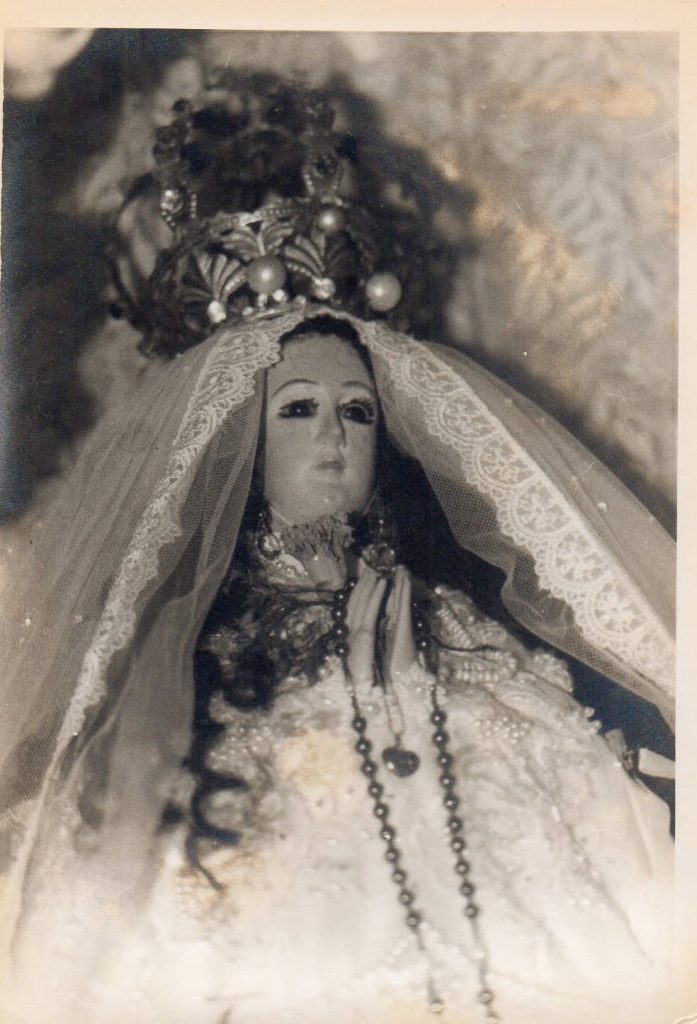
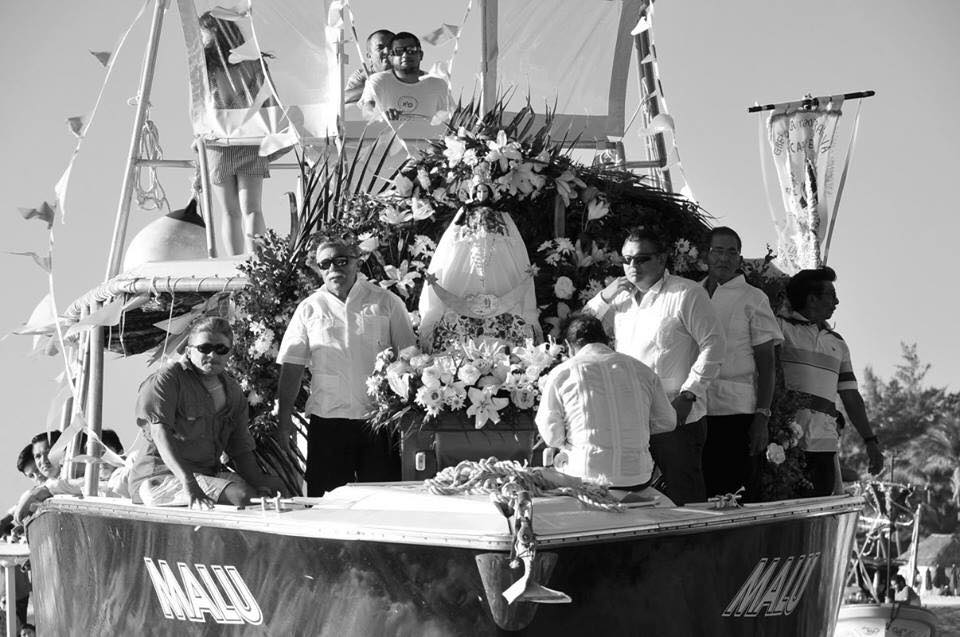
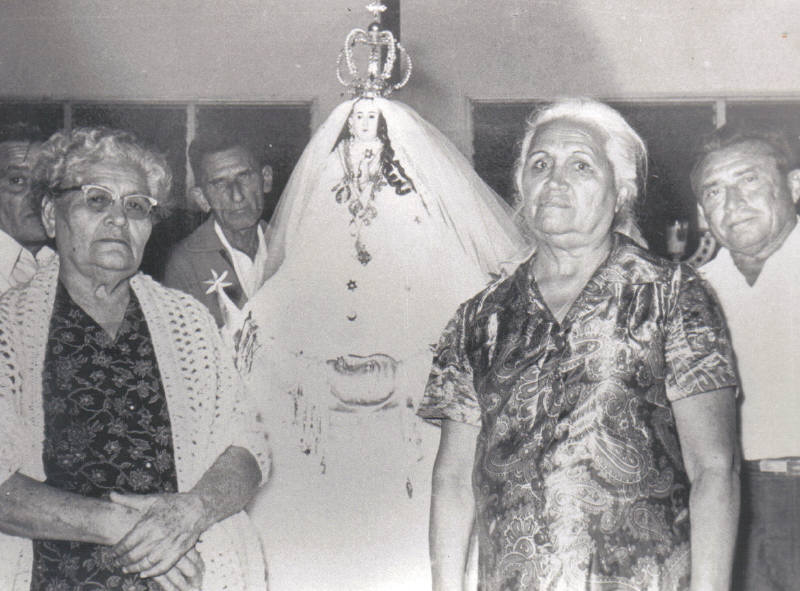
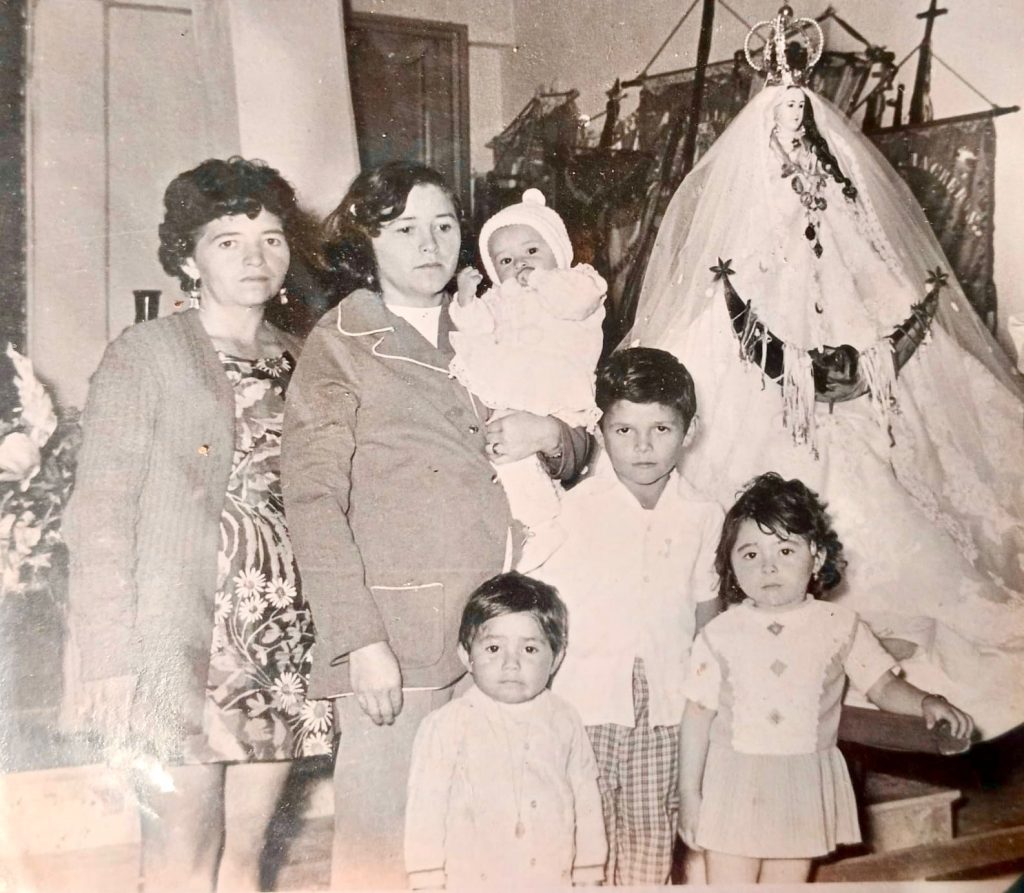
And yet, this only deepens the central question:
How did she arrive at Boca Iglesia, if it was never recorded that an image of the Immaculate Conception was ever brought from Spain to Boca Iglesia in the time that the Obispado was established there?
Historical context offers fragments, but no definitive answer. At the end of the 1550s, Diego de Landa traveled to Guatemala and brought two Marian images back to the Yucatán. These images were distributed across the region, placed in religious centers, replicated, moved, and, over time, lost.
There are also local hypotheses. One suggests that hunters from Lázaro Cárdenas may have brought the image to Boca Iglesia and left it there when they went to hunt wild boar. My opinion is that it is possible that she may have been brought there during the time that the parish of Ekab was still active and was later abandoned there. Don Fidel has also spoken of an identical image of this same figure in a church in a pueblo in Yucatán, suggesting that these representations were not unique, but part of a broader circulation.
And yet, none of this fully explains how the Virgin came to rest within the ruins of Boca Iglesia.
It remains a mystery.
If the people of Isla Mujeres could continue to see her as the Assumption even after being told otherwise, how might the Mayans of Ekab have received these images when they were first introduced to them? Not only the Immaculate Conception, but earlier figures like the Virgen de los Remedios, who was presented to the Maya and was depicted standing upon a crescent moon — a symbol deeply tied to cycles, fertility, and the feminine, the same elements that have long defined the spiritual language of this region. The Immaculate Conception would later carry this same lunar symbolism forward.
Did they see something foreign, or something familiar?
Did they see the Virgin, or did they see Ixchel?
Maybe it was coincidence.
Maybe it was intentional.
Maybe it was a translation.
Or maybe it was Ixchel reincarnated in a way that the new world could understand.
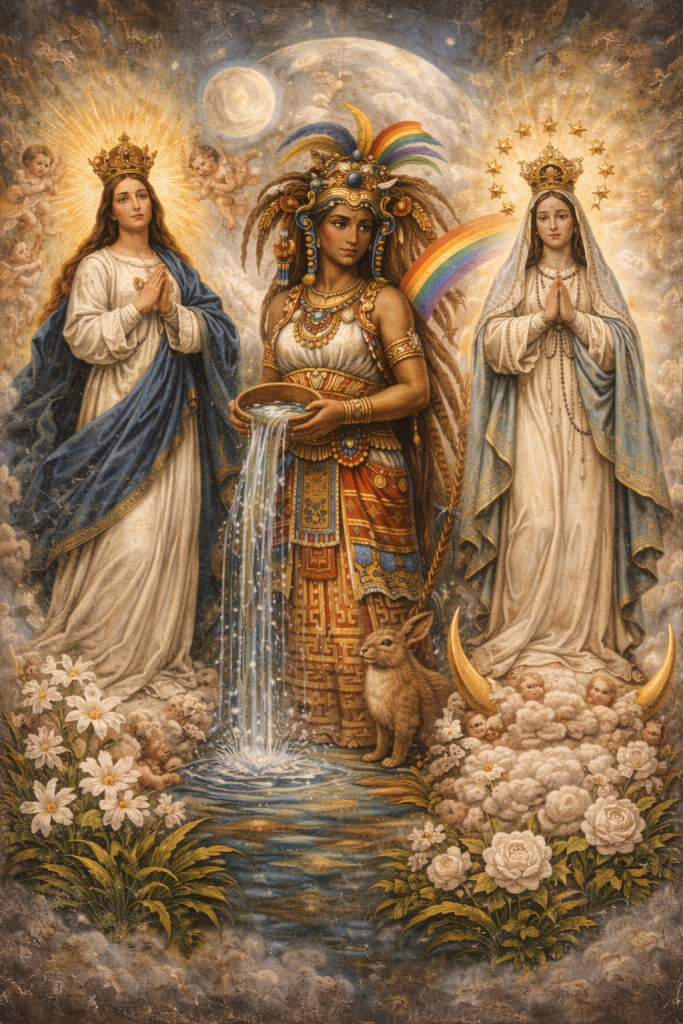
Perhaps what we are seeing is something more enduring — the ability for one sacred figure to hold many meanings at once. A single image, carrying multiple names, multiple histories, multiple ways of being understood. Not contradiction, but coexistence.
Because Ixchel never needed to disappear.
She remained — in symbol, in rhythm, in the language of the feminine, in the moon beneath her feet, in the generations of prayer and devotion to her on this soil.
And in Isla Mujeres, she can still be found.
Not only in the ruins at Punta Sur, where she once faced the sea — but also in the church in the town square, where the Virgin of the Immaculate Conception continues to be venerated, the very same figure that the island’s early fishermen brought back to the island from Boca Iglesia. Different names, different devotions — and yet something remains continuous beneath them.
Not replaced.
Still present.
Boca Iglesia is not only a place of origin — it is a place of continuity. A threshold where belief was not replaced, but layered. Where one story did not disappear, but learned to live inside another. And perhaps that is why it remains so difficult to reach — because it was never meant to be simply visited, but understood.
Crossing into boca iglesia
The first time I heard about Boca Iglesia was years before I understood what it was. During the administration of Agapito Magaña (2013–2016), his wife, Marty Vargas — then presidenta del DIF in Isla Mujeres and a deeply devoted Catholic — would occasionally travel there with Don Fidel Villanueva Madrid, often accompanied by a priest. I remember hearing about these visits almost in passing — a place far away, difficult to reach, tied to something religious, but undefined. At the time, it didn’t mean much to me. It felt distant, abstract, like a story that existed but was not yet mine.
It wasn’t until 2018, when my foundation Arte Mutuo was commissioned to create a series of murals across the island — visual narratives of its history, memory, and identity — that Boca Iglesia revealed itself in a different way. One of those murals, curated with Don Fidel, depicted Ixchel — the first deity of this place — together with the Virgin of the Immaculate Conception, the patroness of the island. Two female figures, separated by centuries yet rooted in the same land. I arrived here when I was six years old, in 1989, and grew up within the rhythm of this island. And still, somehow, Boca Iglesia had never been spoken of to me.
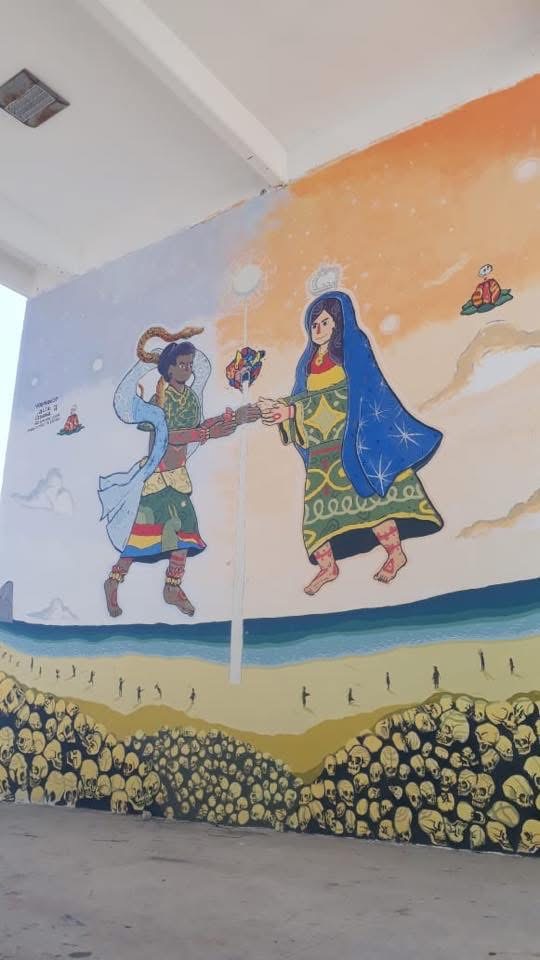
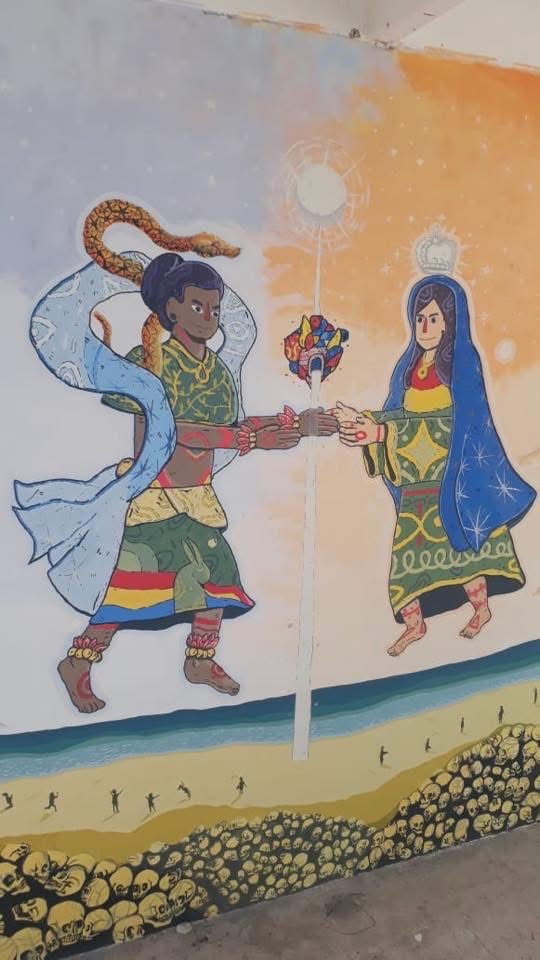
Mural by Alex Lechuga, Rosaura Luna and Pablo Moctezuma in collaboration with ARTE Mutuo
On April 7th, 2026, I finally crossed to Boca Iglesia by boat — alongside Don Fidel and Nico Rivero, my daughter’s great uncle and one of the propietarios of the lands surrounding Boca Iglesia. The journey took nearly two hours, passing Isla Contoy and then entering a vast, shallow lagoon — still, expansive, almost disorienting in its openness. At one point we asked where the other opening led. “Sale a Holbox,” they told us. A passage, a connection.
Even there, nothing felt isolated.
The boat slowed before the shoreline, then stopped. Flamingos moved overhead in a slow, deliberate line, their wings catching the light. Along the edge of the water, mantarrayas traced the sand beneath the surface — quiet, gliding, almost invisible, creatures of transition between worlds. It reminded me of Isla Contoy as I remember it from childhood — untouched, suspended in its own rhythm. Then we stepped into the mud.
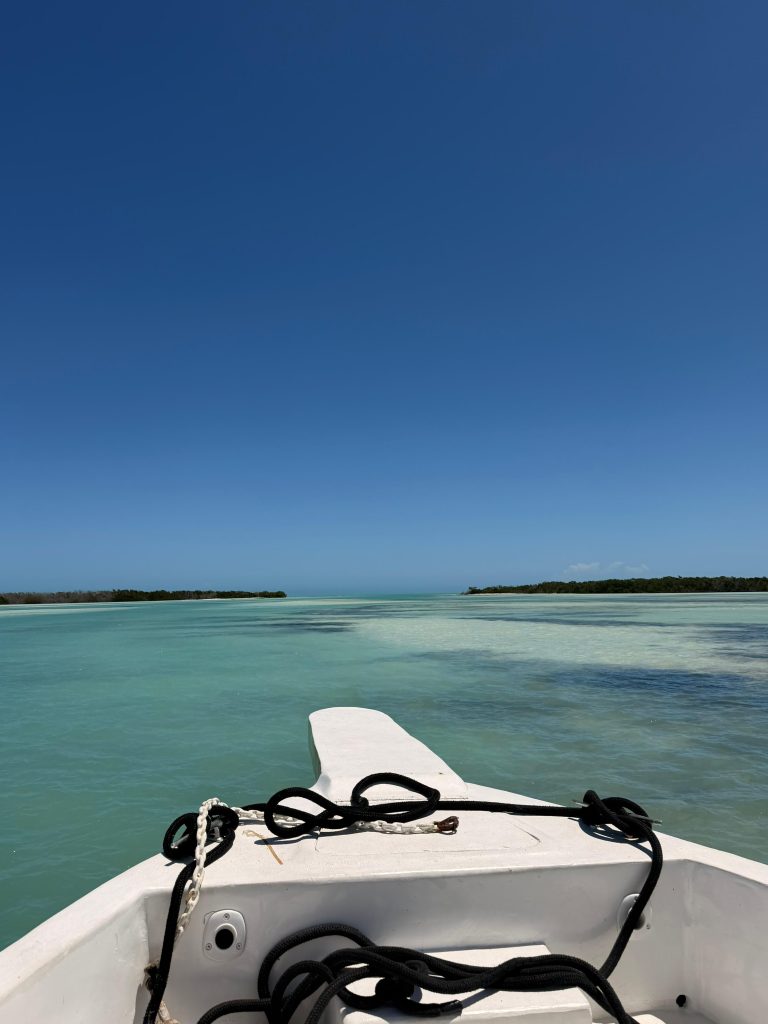
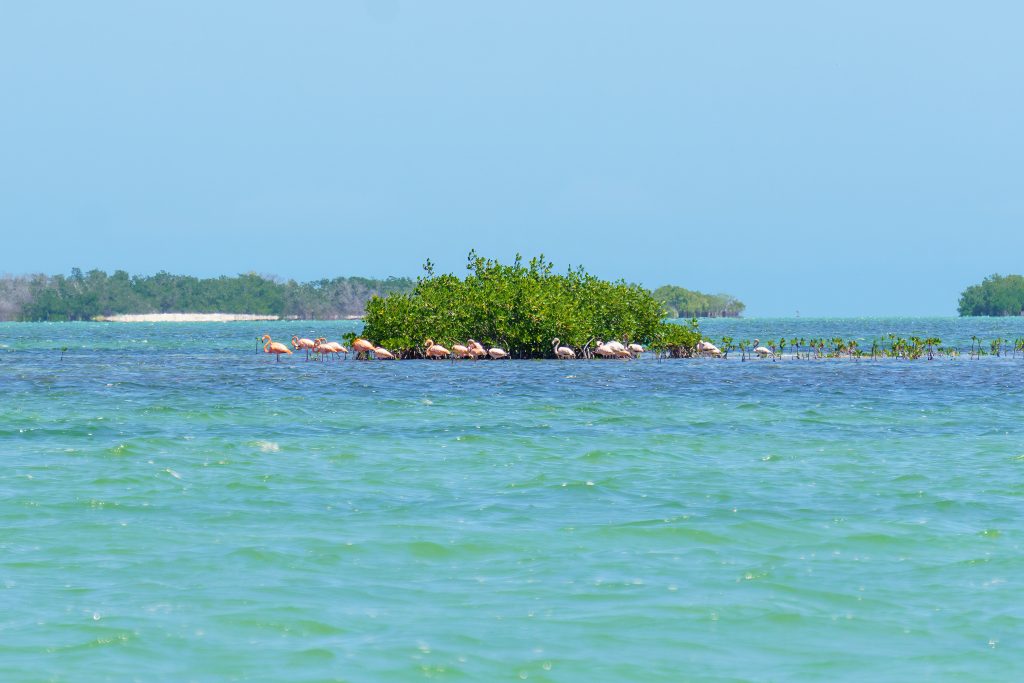
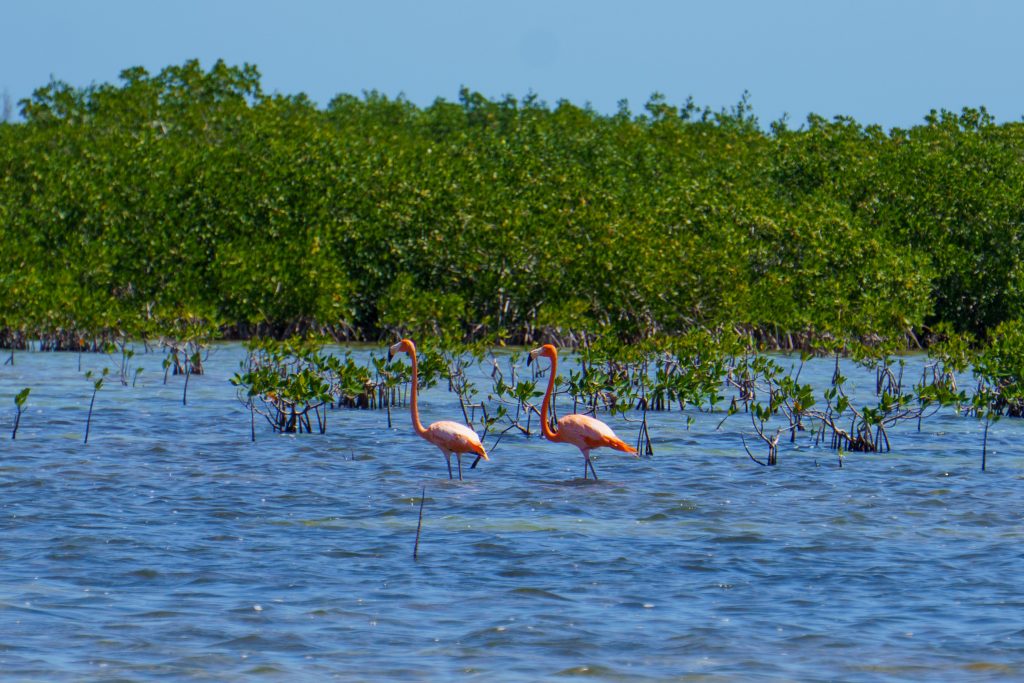
It rose higher than expected, thick and resistant, pulling at every movement. There was no path, only effort. Don Fidel and I moved first, slowly, testing the ground before committing our weight. By the time we reached the shade, the air shifted. We paused beneath mangroves and salt-stained trees when Don Fidel turned toward the shoreline we had just crossed and said, “Imagínate cuando ellos desembarcaron aquí.” And for a moment, I could — not as history, but as resistance, as uncertainty, as a place that does not open easily and asks something of you before it lets you in.
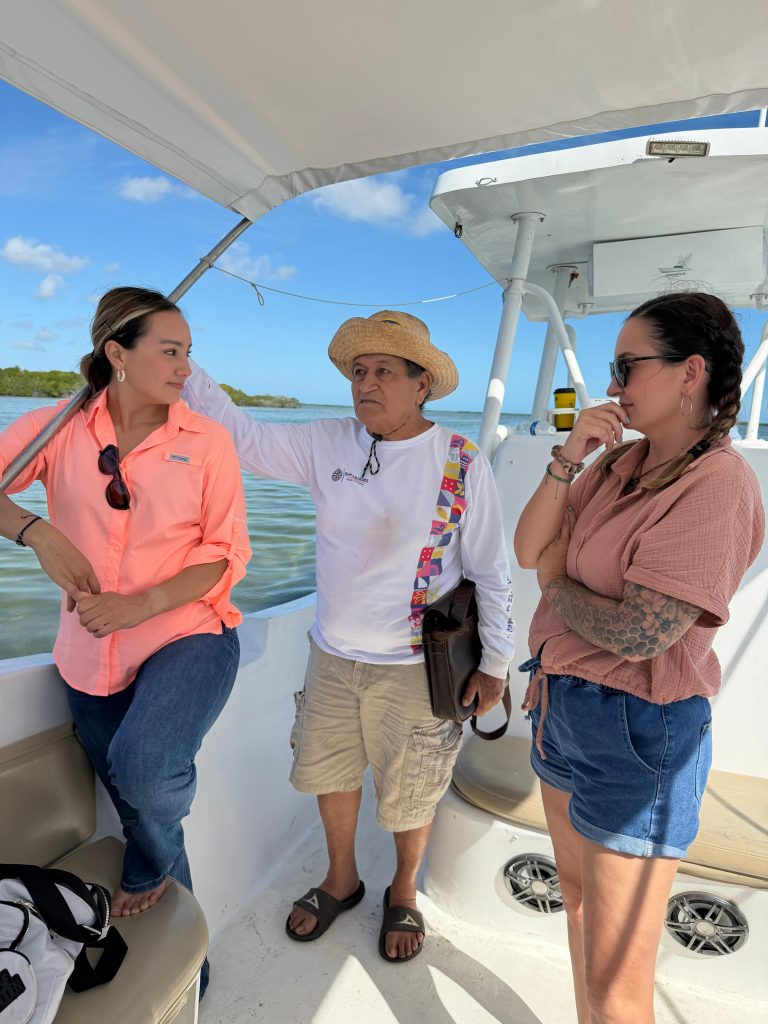
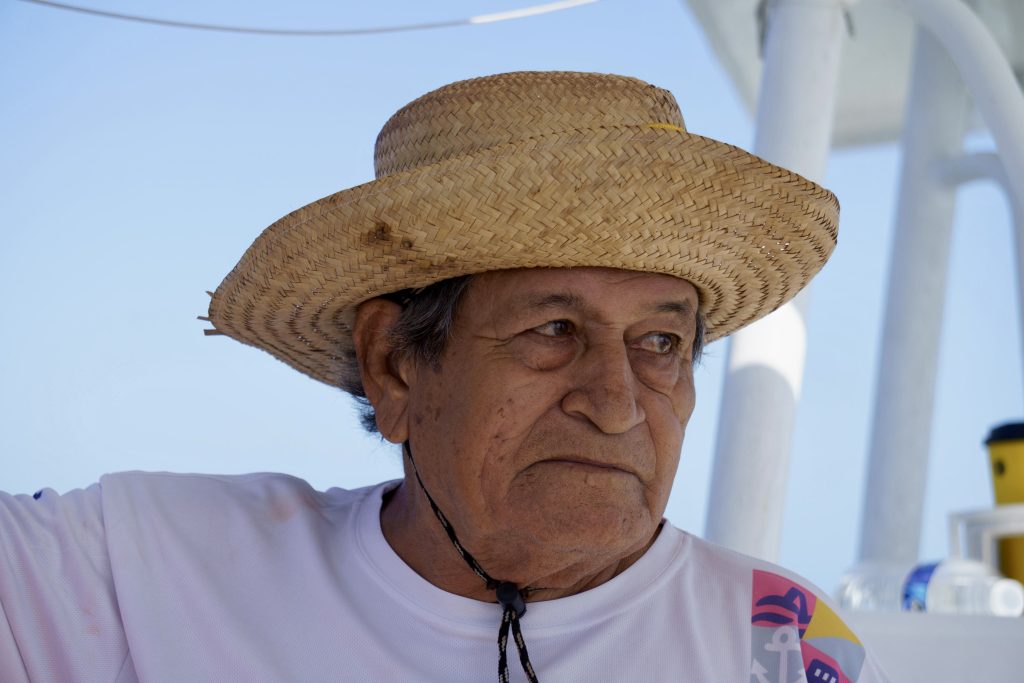
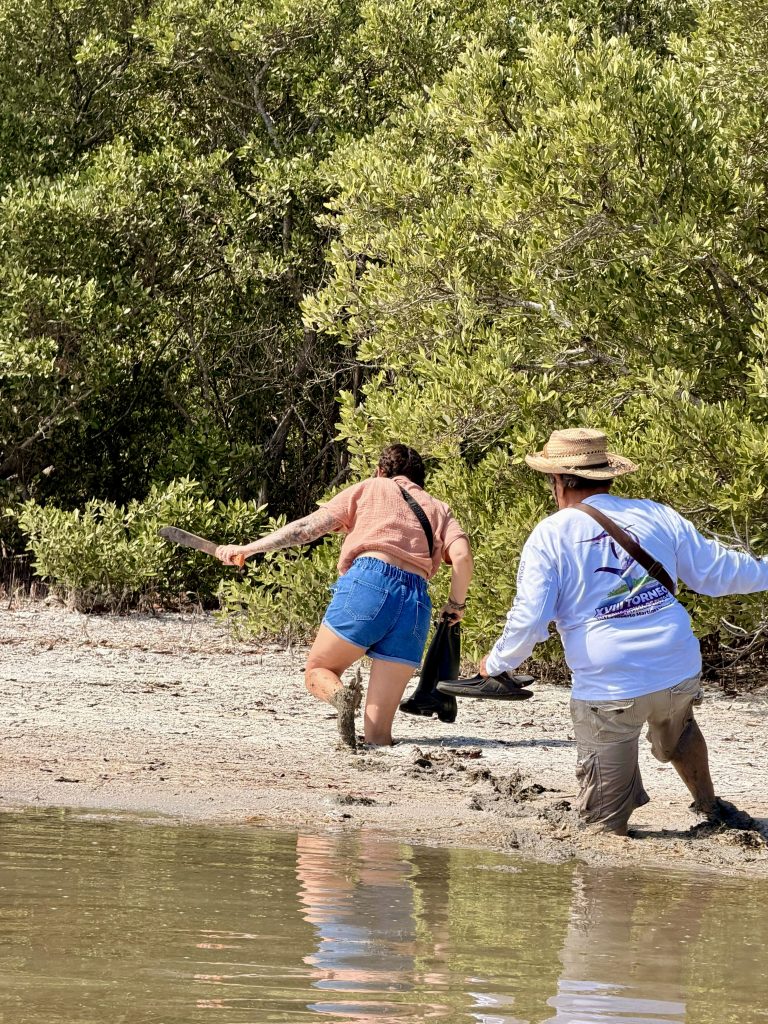
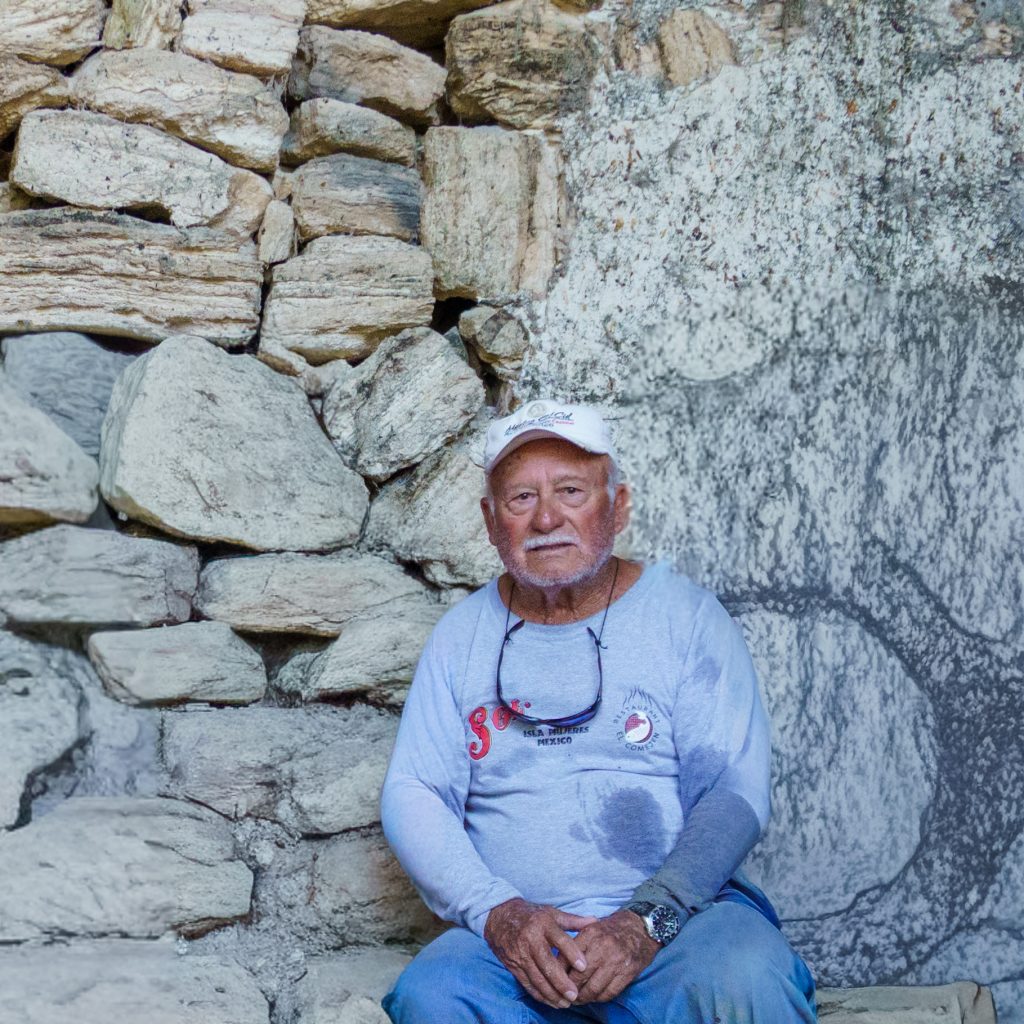
Listening to Don Fidel recount the countless times he has taken his boat — a captain and fisherman himself — across these waters, sometimes within 100 meters of the shoreline, in a small boat with a single motor, speaking of the plentitude that once existed here, brings the place vividly to life. The way he tells these stories — poetic, precise, lived — allows you to almost see it as it once was. He is not only a historian, but a guardian of this place, its memory, its culture, and its meaning.
Nothing about Boca Iglesia feels accessible. It is difficult, resistant, almost unwilling to be entered. The land does not guide you in — it slows you, holds you, tests you. There is something in that resistance that feels older than history, something sacred and idólatra in the deepest sense of the word — not in opposition, but in presence.
The ruins reveal themselves slowly. There is no grand entrance, no clear boundary, no explanation waiting for you. Only the sense that you have arrived somewhere that was never meant to be easily found. Some of the stones still hold their own story — large, squared blocks that seem to have been reused from Mayan structures, set alongside more uniform rectangular stones that speak of Spanish construction. Even in the walls, the layers remain visible.
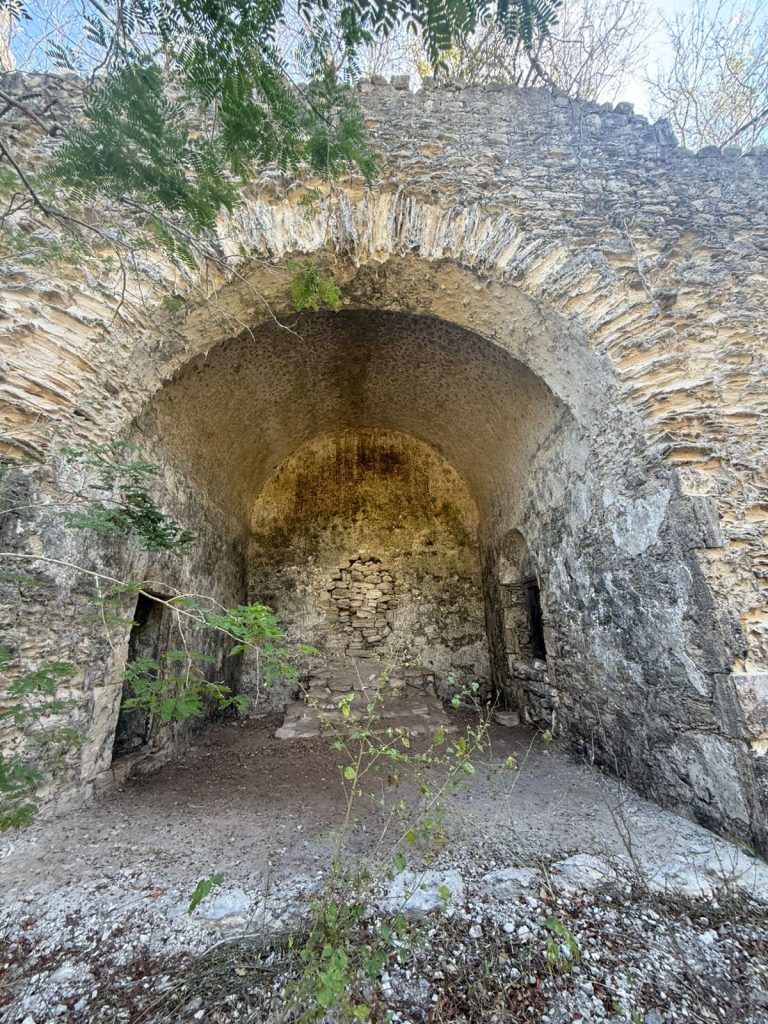
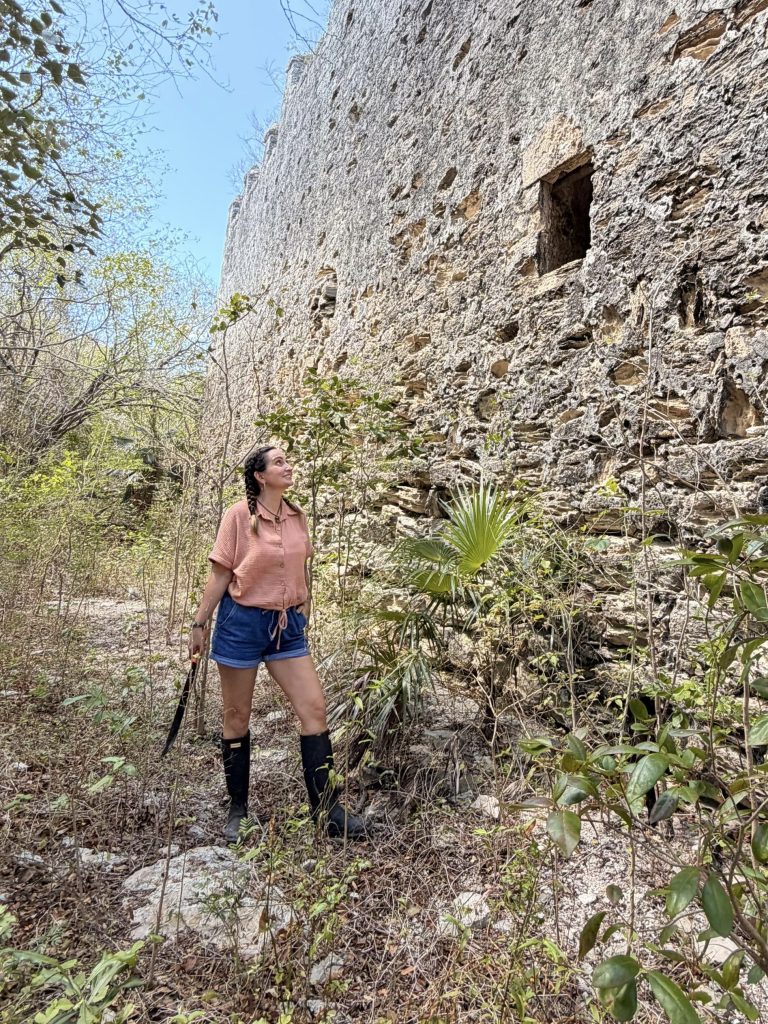
Nico’s presence made that layering feel even more alive. His family has cared for this land for over a century. As propietario of the lands surrounding Boca Iglesia, and one of the few people who truly knows this territory, he carries a different kind of authority — not archival, but lived. Being there with him made it clear that Boca Iglesia is not only a site of history, but a place that still depends on guardianship, memory, and those willing to return to it.
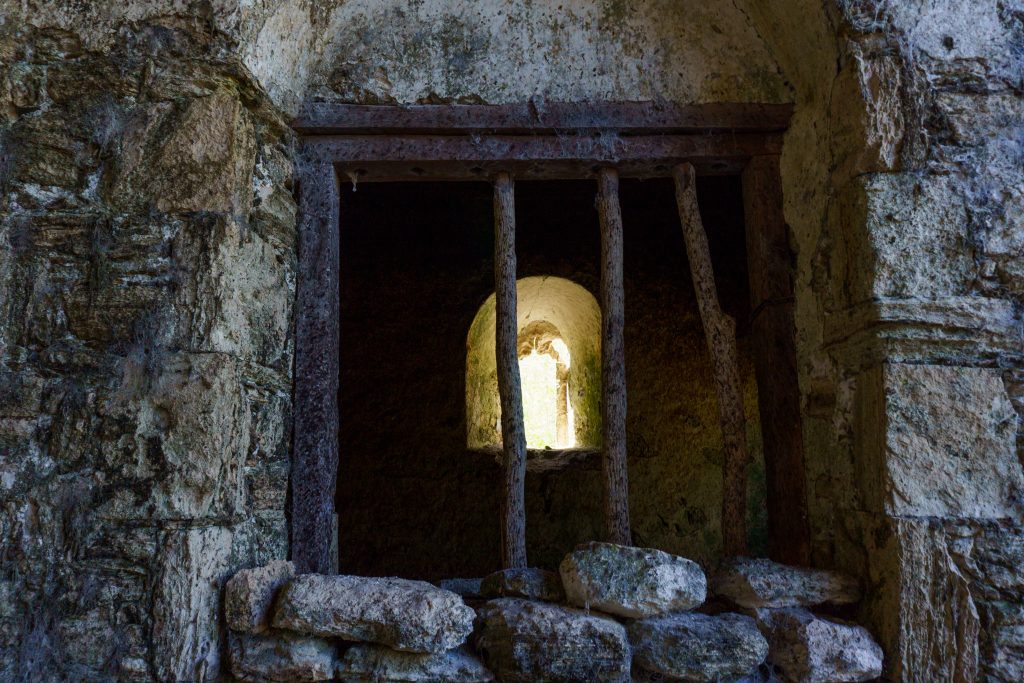
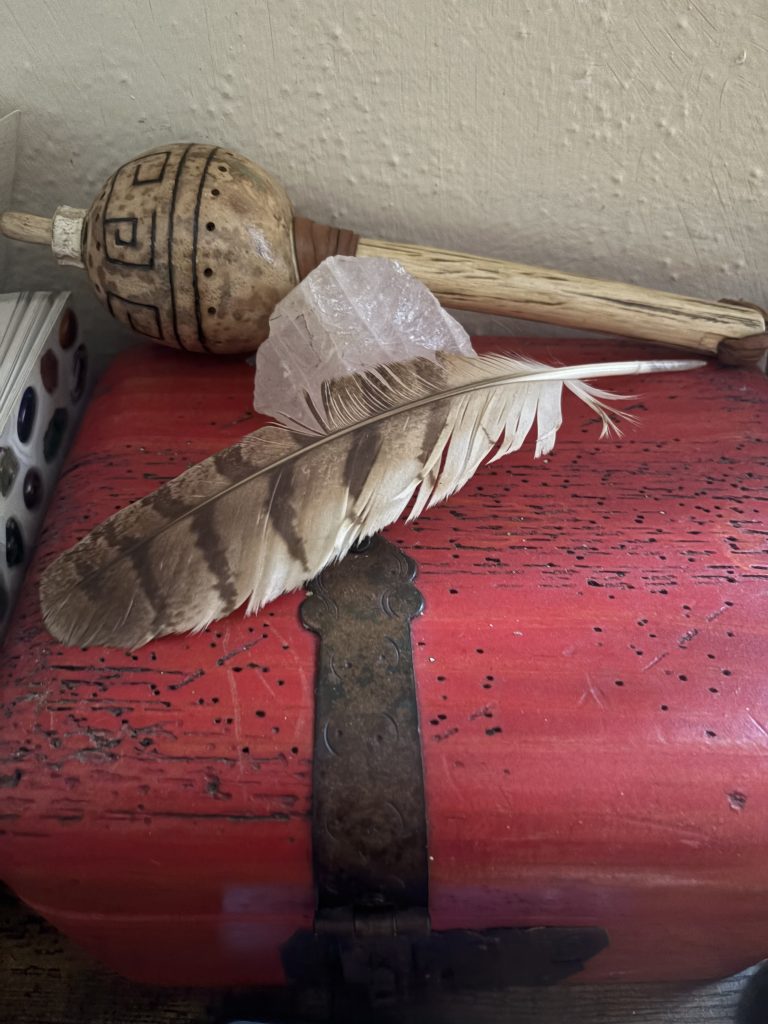
I placed a small offering — a white candle, copal, and a few shells — in gratitude. For the place, for the history, for what allowed us to arrive. The smoke rose softly into the still air.
When I turned around, there was a feather on the ground behind me. It hadn’t been there before, or at least, I hadn’t seen it. Later, my close friend and spiritual guide Edgar Rodríguez Nava, whose family collects feathers from the jungle floor to create jewelry and ceremonial pieces, told me it was lechuza — an owl, a guardian of the night, deeply tied to the moon and the unseen. I thought of Ixchel. I thought of the Virgin standing on the crescent moon. I thought of the mural we painted in 2018, before I had ever been there.
And in that moment, it felt simple. Like a gesture returned. Like a quiet acknowledgment. Like someone — Ixchel, the Virgin, or the place itself — had said thank you.
They say the Church began here.
But something was already here — watching, waiting, and refusing to disappear.
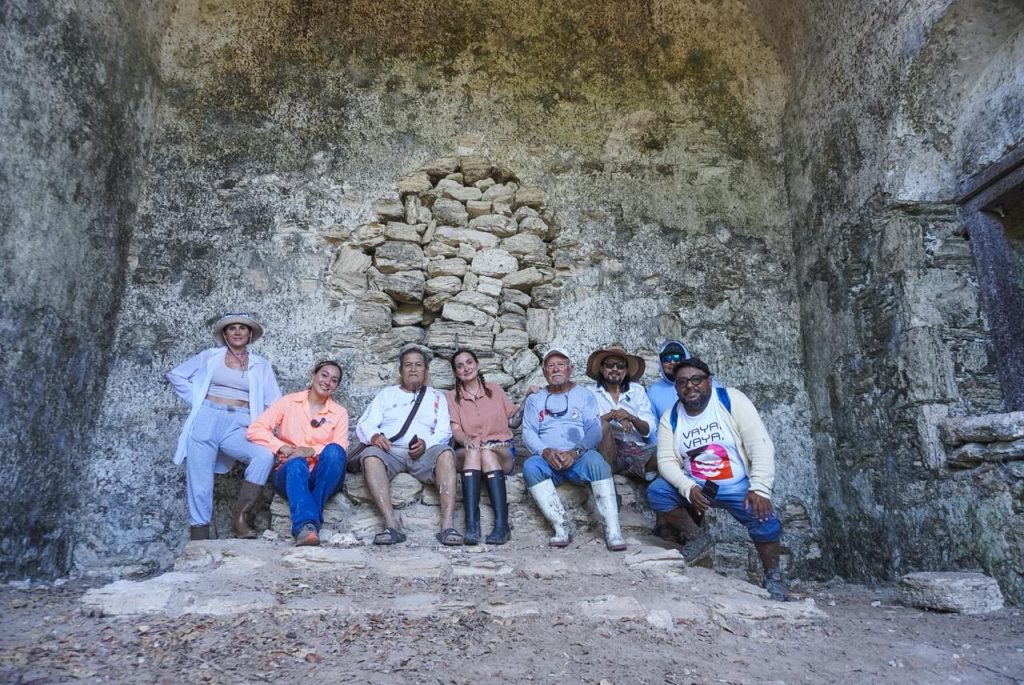
As a collaboration, we invited a group of young voices to be part of this journey — not just to witness it, but to carry it forward. Nadia Petersen moved through the experience with a quiet, spiritual awareness, deeply attuned to the energy of the place. Alex Vallejos brought a reflective lens shaped by travel and observation, offering insight into how spaces like this are perceived and understood by those who arrive from outside. Paloma Peña Olivares carried a deep connection to the island’s identity — through culture, youth, movement, and expression — naturally bridging past and present. Our photographer Regina Ravell and videographer “Chilango” became visual storytellers, capturing not just images, but atmosphere, texture, and presence. And guiding us across the water was our captain, Ángel Rosado Polanco, navigating with a deep respect for the delicacy of these waters and their history. As part of a younger generation, he carries a humility in learning from his elders — listening, observing, and honoring the knowledge passed down to him. Together, each person contributed not just presence, but perspective — helping ensure that the story of Boca Iglesia continues to live, evolve, and reach new generations.
To learn more about Isla Mujeres’ History & Culture, follow the island’s official historian Fidel Villanueva Madrid on his Facebook page.
All photography in this post was done by Regina Ravell Fotografia